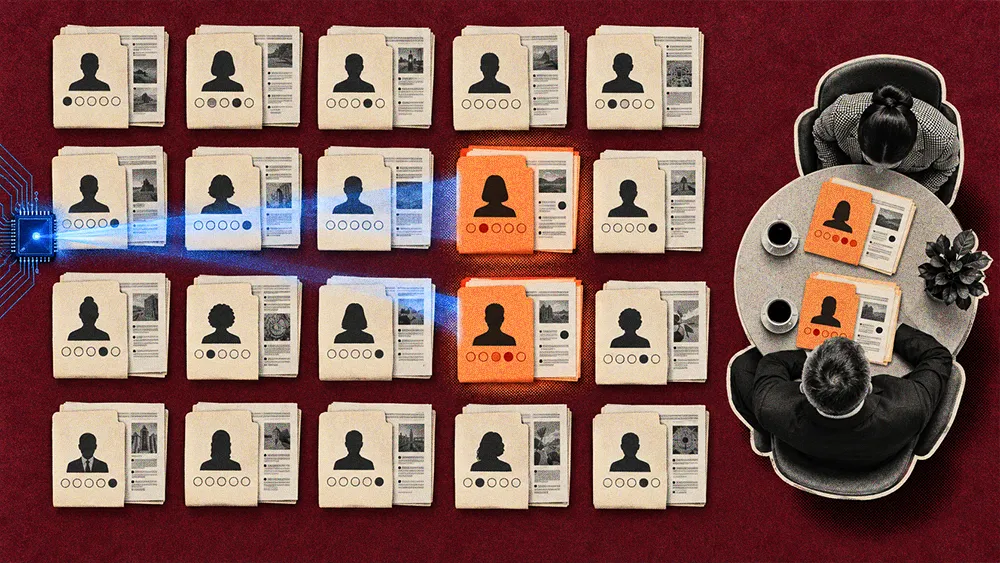


Four in 10 hiring professionals are struggling with candidates who use AI to misrepresent themselves, and more than a third cannot reliably detect it, according to Criteria's 2026-2027 Hiring Benchmark Report. The misrepresentation runs from AI-inflated resumes to deepfake interviews staged by organized fraud networks. Employers that are containing it have moved their decisions onto evidence a candidate has to produce in the moment, including proctored assessments, structured interviews and verified identity.
Candidates' use of AI has outrun employers' ability to spot it. In Criteria's 2026-2027 Hiring Benchmark Report, a survey of 1,027 U.S. hiring professionals released Oct. 6, about 4 in 10 said they are struggling with candidates who use AI to misrepresent themselves, and more than a third said they cannot reliably detect it. Nearly a quarter no longer trust the resume as a reliable signal of what a candidate can do.
The cost is already visible in hiring outcomes. Earlier this year, Criteria and Lighthouse Research & Advisory surveyed 998 employers. Sixty-four percent had hired someone who misrepresented their skills on a resume, 39% had done so more than once, and only a third were very confident that resumes reflect a candidate's true skills.
"What this year's data makes clear is that traditional talent signals are becoming increasingly difficult to trust," Josh Millet, Criteria's co-founder and CEO, said in the announcement of the report.
How candidates are using AI, and why employers miss it
Polish is routine, and a meaningful share crosses the line
AI is now a standard part of applying for a job. Thirty-four percent of job seekers told Criteria in its 2026 Candidate Experience Report that they have used it to apply, and 39% of the 3,290 candidates in a Gartner survey said the same. Most of that use goes into resumes and cover letters. Among the Gartner respondents who used AI, however, 29% used it to answer assessment questions, and in a separate Gartner survey 6% of candidates admitted to outright interview fraud, including having someone else pose as them.
Cisco has stated its rule plainly. "If a candidate is not explicitly invited to use AI during the assessment process, then it should be considered off-limits," Scott McGuckin, the company's vice president of global talent acquisition, told Computerworld. Where no such rule exists, candidates are left to guess and hiring managers decide case by case.
The written application has lost its signal
Research now puts numbers on what recruiters have been seeing. Economists at Yale studied Freelancer.com after the platform introduced an AI cover-letter tool in 2023. Across more than 5 million bids, the relationship between a cover letter's fit with the job and the applicant's chance of a callback fell 51%, and employers shifted their attention to work history and reviews.
Researchers at Dartmouth's Tuck School of Business and Princeton modeled what that loss does to hiring outcomes. Once AI made tailored applications nearly free to produce, the most capable workers in their simulation were hired 19% less often, while the least capable were hired 14% more often. "Employers are receiving around 60 applications within a few minutes," one of the authors told Tuck.
Millet argues the resume was never a strong signal to begin with. "AI has exposed the resume for what it has always been: a limited, one-dimensional snapshot of a candidate," he said when Criteria released the Lighthouse findings.
Organized fraud raises the stakes
At the far end are candidates who are not who they claim to be. Gartner predicts that by 2028, one in four candidate profiles worldwide will be fake, and Jamie Kohn, a senior research director in its HR practice, has warned that "candidate fraud creates cybersecurity risks that can be far more serious than making a bad hire."
The best-documented cases involve North Korean IT workers who use stolen identities to win remote jobs at U.S. companies. An Arizona woman who helped run one such scheme was sentenced to 102 months in July 2025 after it reached 309 U.S. businesses and used 68 stolen identities. In July 2026, the United States and ten allied governments issued a joint alert warning that these workers are using AI to conceal their identities and telling employers to watch for manipulated video feeds. "We're seeing AI use across that entire spectrum of the DPRK remote worker, from application to employment," Todd Hemmen, an FBI deputy assistant director, said in July.
What works against it
In-person interviews answer only part of the problem
Google, Cisco and McKinsey have reinstated in-person rounds. Google CEO Sundar Pichai said in 2025 that the company would "introduce at least one round of in-person interviews for people, just to make sure the fundamentals are there," and the FBI and its international partners now recommend in-person interviews as a defense against fraudulent remote workers.
An in-person round confirms that a candidate is real, but it adds travel costs, slows hiring and narrows the pool for people in smaller markets or with caregiving duties. As Talent Signal News has reported, an unstructured conversation remains a weak predictor of job performance whether it takes place over video or across a conference table.
Skills evidence carries more weight than self-reported claims
Employers in the Criteria and Lighthouse study were nearly unanimous on this point, with 98% rating skills assessments, structured interviews and work samples as more reliable than resumes. Structured interviews, which put the same job-related questions to every candidate and score the answers against a defined rubric, are among the best-validated tools in hiring research. "Structured interviewing is two times more predictive than unstructured interviewing, but it's always been pretty hard for companies to execute well," Millet said when Criteria launched its interview scoring product.
Online assessments need safeguards of their own. Timed tests, large question banks and adaptive formats make answers harder to look up, and proctoring confirms that the person taking the test is the person who applied. Criteria, which sponsors Talent Signal News, offers AI proctoring that verifies candidate identity and flags signs of outside help, such as a second device or copied answers.
Identity checks and clear rules close the remaining gaps
For roles with access to sensitive systems, federal guidance is specific. The FBI advises employers to build identity verification into interviewing and onboarding, complete as much of the process in person as possible, and check applications for reused resumes, phone numbers and email addresses.
Chris Daden, Criteria's chief technology and AI officer, has cautioned that "there's really no single silver bullet that will prevent AI cheating," and he advises employers to treat candidates as acting in good faith from the start. That means telling applicants up front which uses of AI are allowed at each stage, explaining how assessments are monitored and letting them know results may be verified later.
FAQ
What is AI candidate fraud?
AI candidate fraud covers any use of AI by a job applicant to misrepresent who they are or what they can do. It includes resumes that overstate skills, AI-generated answers to assessments or live interview questions, and in the most serious cases, fake identities or deepfake video used to get hired. Using AI to polish a resume or prepare for an interview is generally not considered fraud.
How common is it?
In Criteria's 2026-2027 Hiring Benchmark Report, about 4 in 10 hiring professionals said they are struggling with candidates who use AI to misrepresent themselves. A Gartner survey found that 6% of candidates admitted to interview fraud, and Gartner predicts that one in four candidate profiles worldwide will be fake by 2028.
Can employers detect candidates using AI in interviews?
Not reliably. More than a third of hiring professionals in Criteria's survey said they can't consistently detect AI misrepresentation. Structured interviews, proctored assessments and identity verification make it harder for candidates to rely on AI where it isn't allowed.
Are companies going back to in-person interviews because of AI?
Some are. Google, Cisco and McKinsey have added in-person rounds, and the FBI recommends in-person interviews to guard against fraudulent remote applicants. In-person interviews add cost and time, so many employers are pairing them with or replacing them by skills assessments and structured interviews.
Is the resume still useful?
Far less than it was. Nearly a quarter of hiring professionals in Criteria's latest survey said they no longer trust the resume as a reliable signal, and research from Yale found that cover letters lost about half of their power to predict callbacks after AI writing tools became available.