


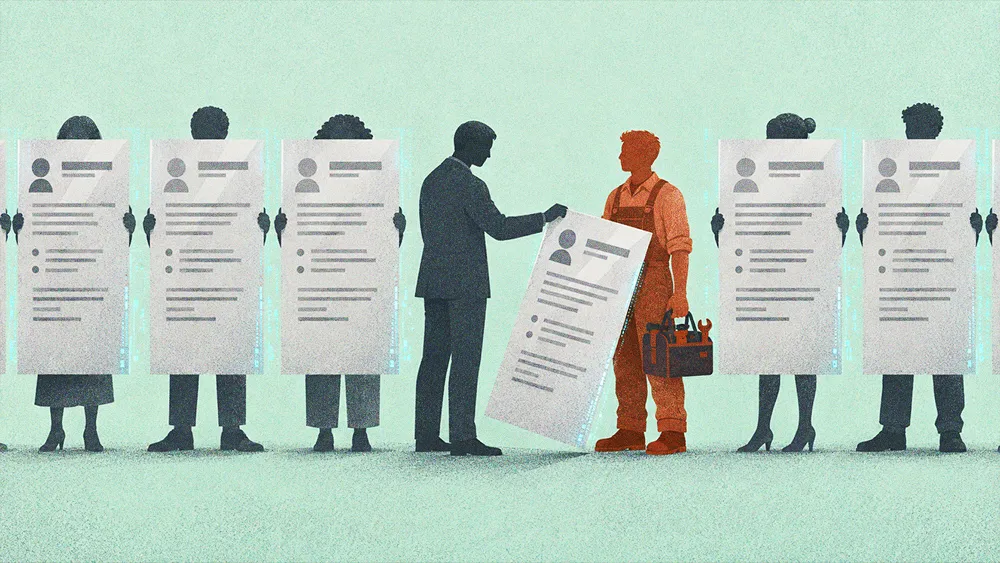
For most of hiring's history, a strong resume was a reasonable proxy for a strong candidate, because writing one that looked elite took effort that tracked, loosely, with the ability behind it. That link is gone. A candidate can now paste a job description into a chatbot, ask it to make the resume perfect, and get back a flawless document in seconds. The result is a stack of applications that all look exceptional and prove almost nothing, which has turned the recruiter's job from reading resumes into verifying that the person behind one is real and can actually do the work.
Frank Strick is a Talent Acquisition Partner at Empower Pharmacy, where he hires across a wide range of roles, from full-stack engineers to compliance and quality positions in a regulated manufacturing environment. He describes himself as the generalist who gets pulled onto whatever req is on fire, which has given him a wide, current view of how the top of the funnel has changed. His account of that change is blunt.
"It's easier than ever to build a resume. You have more good resumes coming in than ever before. Then the question is, how do you detect fraud? How can you really evaluate if these resumes make sense?" Strick says. These are questions reshaping his whole process, and answering them starts with accepting that in many cases the resume now works against him.
The signal didn't just weaken, it inverted
The uncomfortable part of Strick's experience is that the polish now runs in the wrong direction. The resumes that look most impressive are often the least trustworthy, because looking impressive is what the tools do reliably. A couple short years ago, he says, a bad application announced itself. "Two years ago it was very, very rare to see a fraudulent resume, or it was so obvious you could tell right away," he says. The tells that used to give it away, like an impossible location or a VPN left on, have been engineered out. What's left is a screen full of candidates who all read as excellent, and a recruiter who can no longer take any of it at face value.
The industry data says this isn't an isolated problem. In Criteria's recent Hiring Benchmark Report, a survey of more than 1,000 hiring professionals, four in ten said they struggle with candidates using AI to misrepresent themselves, and more than a third admitted they can't reliably detect it. Nearly a quarter said they no longer trust the resume as a reliable signal at all. The document that used to anchor the process has become the part of the file people trust least.
Why the market made this worse
Strick is clear that the surge is the product of a labor market he calls the most brutal since the financial crisis, where the leverage has swung hard toward employers and many candidates feel desperate. More than half of hiring professionals in the Criteria survey agreed hiring is harder this year than last. "COVID was candidate-driven. You could apply to jobs getting 40% comp increases. Now it's the complete opposite," he explains. "If you get laid off, if you come from big tech, you're not necessarily desirable anymore."
Add the global economics of remote work, where some applicants misrepresent location or identity to reach higher-paying roles, and the point for a hiring team isn't the motive but the volume. When desperation meets a tool that fabricates polish for free, the funnel fills with applications that defeat the old way of reading them.
What fills the gap when the resume can't
With the document hollowed out, Strick has moved his attention to signals a generator doesn't think to fake. The striking thing is how little of it is about technical skill at first, and how much is about coherence, whether the details of a person's story actually hang together. He starts somewhere unglamorous. "All you need to know is in the detail," he says, pointing to things like an email address that routes through a commercial domain rather than a personal account or a resume that omits a location entirely, which he treats as a flag worth a direct question.
Then, he listens to language. "How does the wording sound? For example, does the person use the word 'client' or 'contractor'?" In this case, he's describing an interaction where a candidate kept referring to a purported full-time employer as a client. A little pressure revealed the story didn't hold.
Strick's most reliable move is to leave the skill set aside and ask about lived detail. A candidate who claims eight years of experience in Manhattan should be able to name a favorite pizza spot and a cross street; one who claims a degree from a particular school should know its mascot. "A lot of the time it's asking questions not related to the skill set that catches them," he says. By this method, the recruiter reconstructs by hand the thing the resume used to certify: that this is a specific, real person with a specific, real history.
Judgment is hard to scale, so pair it with tooling
Strick is candid that his own instincts don't transfer cleanly to a junior recruiter or a team under volume, which is the real problem for most organizations. His answer is to put a verification layer underneath them, then leave the decision to a human.
The category of tooling he relies on pulls a candidate's public footprint into a single view and surfaces the signals a recruiter can't eyeball at scale: whether a phone number is VoIP, how recently an email was created, where an IP address resolves. It returns a quick read, a low, medium, or high suspicion flag, that a recruiter can scan in seconds and then judge. "Use the tech, but leave the decision to the recruiter," he advises. For teams without a budget for it, he keeps a running sheet of red flags at his desk and updates it as new tactics appear, treating detection as a skill to be trained rather than a gate to be bought.
That split between technology to triage and a person to decide is the posture the benchmark data points toward, too. More than half of hiring teams now use AI somewhere in the process, most often to screen, but Strick draws a hard line at letting it reject candidates on its own. He'd rather customize the filters in his applicant tracking system and keep a human reading every rejection than trust an auto-filter that candidates routinely report has discarded a legitimate resume.
The obvious worry is that all this scrutiny punishes the honest applicant. Strick's experience is that it doesn't, as long as the team is transparent about what it's doing and why. "It comes down to communication. As long as the communication is good, there's never been an issue." When identity or background checks come early, he explains the reason plainly. A real candidate looking for a real job complies without friction, while the ones who vanish at that step tend to answer the question for him.
The job changed, and so must the skill
What Strick described is less a set of tricks than a redefinition of what screening is for. When the resume certified identity and capability, the recruiter's job was to read it. Now that a model can manufacture the document, the job is to establish the two things the document no longer proves: that the person is who they claim to be, and that they can do what they claim to do, without a tool answering for them.
"When you tell people, 'Don't use those tools,' a lot of them can't do anything," he says, describing candidates whose demonstrated skill evaporates the moment the AI is switched off. That's the case for shifting weight off the resume and onto verification and demonstrated ability. The teams that adapt will treat the resume as the least reliable part of the file and build their confidence somewhere the generator can't reach. The ones that don't will keep hiring the candidate with the best prompt.