

The candidate on the screen smiles, pauses in the right places, and answers the curveball question about a gap in his resume with an easy laugh. His lips match his words. His references will pick up the phone. He does not exist.
A person with no image manipulation experience can assemble a fake candidate capable of passing a video interview in roughly 70 minutes, according to researchers at Palo Alto Networks. The kit is off the shelf. Real-time face-swap software animates a synthetic face over the live feed while voice cloning replaces the speaker's voice entirely. An answer generator listens to the interviewer's questions and feeds polished responses to the person behind the mask. All of it runs on consumer hardware, and all of it improves monthly.
The fiction starts before the call
The paper trail comes first. A LinkedIn profile with a plausible job history and a few hundred connections. A resume tuned to the job description. Work samples generated in an afternoon. By the time the recruiter opens the application, the fiction is already several layers deep, and from the outside it looks like every legitimate application in the pile. The performance has even gone public: clips circulate on TikTok and Instagram showing candidates running real-time answer generators during live interviews, some posted as bragging, some as advertising for the tools themselves.
Interviewers think they can tell. They can't.
When the interview platform InCruiter launched deepfake detection in early 2026, it found fraudulent activity in 25 to 30 percent of flagged sessions, nearly double what its experienced human interviewers had been catching on their own. In a recent survey of hiring managers, 59 percent said they suspected candidates of using AI to misrepresent themselves. Suspicion is not detection.
The scale of exposure is no longer speculative. A study reported by CBS News finds half of businesses have encountered AI-driven deepfake fraud in some form, and Experian ranks fake job candidates among the top five fraud threats of 2026. The economics explain the growth. Building a synthetic applicant costs almost nothing, the tools are subscription software rather than specialist skills, and a single successful placement can return a salary, corporate access, or both for months before discovery. Fraud follows return on investment, and right now few schemes pay better.
Count what survives
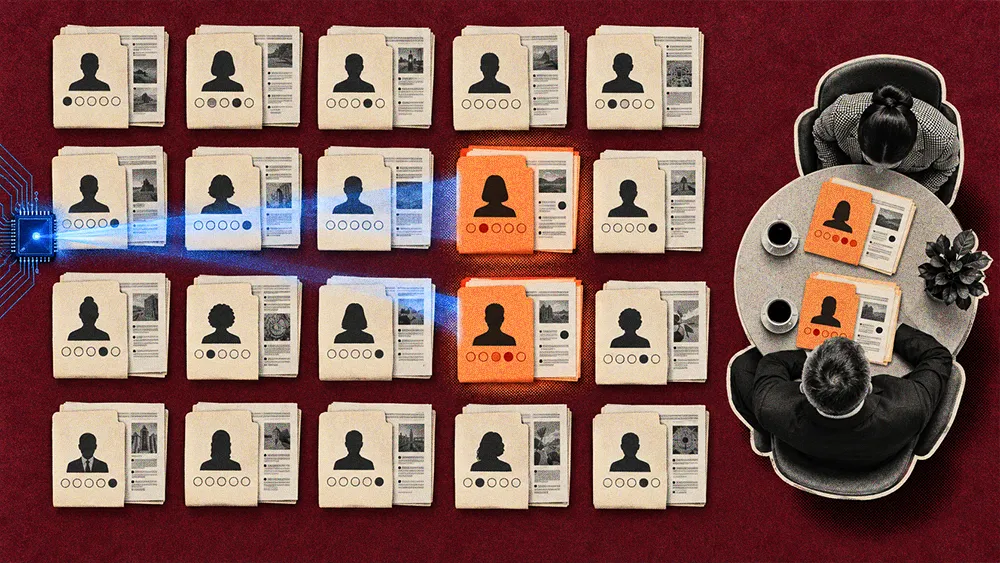
Walk through the standard hiring funnel. The resume can be generated and the profile fabricated. The portfolio can be produced by a model. The face can be swapped, the voice cloned, the answers scripted in real time. The reference can be an accomplice with a burner number. Every artifact a candidate submits is now, in principle, manufacturable.
What remains is the category of things a candidate must do rather than provide. A proctored, identity-verified assessment asks the person to perform under observation, in a session designed to confirm that the individual completing the work is the individual being hired. Skill doesn't transfer through a face swap. Problem solving can't be uploaded from a script. The evaluation industry has spent years arguing that demonstrated ability beats claimed ability as a predictor of performance. The fraud wave has added a blunter argument: demonstrated ability is also the only thing left that can't be faked in 70 minutes.
The resume passed. The human did not exist. Companies that can't tell the difference between those two sentences are the ones this era is going to be hardest on.