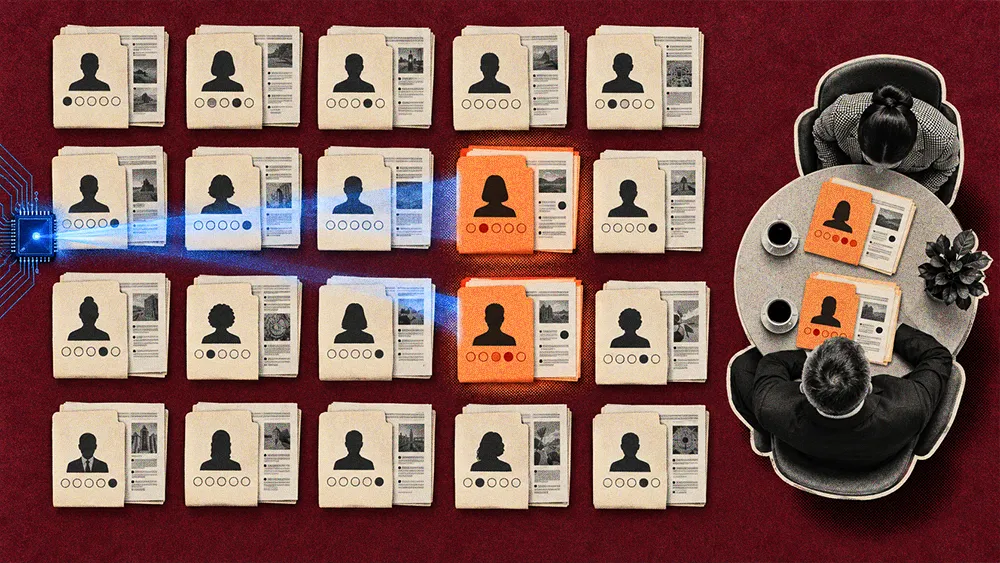




Most of us recruiters use LinkedIn because that's just a tool of the trade. But there are so many ways people present their work.
 Marta MierzejewskaRecruiter @ Dominion Dynamics
The resume was always a summary a person chose to write about themselves. Now it's often a summary an AI wrote, and for a growing number of strong candidates it was never written at all. Criteria's benchmark report found 24% of hiring professionals no longer trust the resume as a reliable signal, and the proof of what someone can actually do usually sits in places the application leaves out. A lot of the useful AI work in recruiting now points in that direction: finding that evidence, and checking it.
Marta Mierzejewska is a Recruiter at Dominion Dynamics, an Ottawa-based company building a dual-use Arctic sensing network for military and civilian use. She spent four and a half years in technical recruiting at Zapier, hiring across engineering, product, design, data, and leadership for a distributed global team, and before that recruited engineering and security roles at Shopify. Mierzejewska builds her own agentic recruiting workflows, including a sourcing agent that checks a claim on a resume against the tools a company's own job postings say it uses.
"Most of us recruiters use LinkedIn because that's just a tool of the trade. But there are so many ways people present their work. So many of them keep their own blogs, and we can build tools that'll help us scan that and understand what they're working on," says Mierzejewska.
Candidates without a resume
At Dominion Dynamics, which hires many veterans, Mierzejewska runs into people the standard application was never built for. Someone who spent 25 years in the Canadian Armed Forces might not arrive with a public GitHub repository, and they may arrive with no resume at all, having worked for decades inside a structured environment that never asked for one. Reading that absence as a verdict on ability gets the person wrong on two counts.
"Saying to certain groups that their resume doesn't mean anything is not only unfair, but also not accurate," she says. "They have so many other skills, and those skills can be very applicable to what we do."
The resume doesn't disappear from her process so much as change jobs. Mierzejewska still wants some highlight of what a candidate has done, enough to give the conversation that follows a place to start. The skills that make a veteran valuable aren't always the ones a skills-first posting thinks to ask for, so the document works as a map into the interview, something she digs into through conversation. "You still have to rely on a roadmap, or a highlight of what they've done, so that through conversations we can dig in and understand what they do," she explains.
Where the proof actually lives
In a previous role, Mierzejewska was hired to find a head of department for a technology that was essentially brand new. Years of experience couldn't serve as a filter, because the thing itself hadn't existed long enough for anyone to have a decade with it. Seniority had to be read some other way.
"Seniority in a role like that does not necessarily stem from years of experience, but rather from working with something that's innovative, and how they worked with it, how they delivered it," she says.
So she looked where that kind of work actually surfaces: Instagram tags from the conferences those people spoke at, published papers, community groups, personal blogs. A network built over years in the industry gave her a second read on whether a claim held up. A candidate's own work tends to live in a dozen scattered places, and the same kind of tooling that reads one source can be aimed at the rest, scanning for what someone actually builds and argues.
Past the polished answer
The tooling that surfaces hidden candidates also floods the pipeline with noise. A large share of the resumes Mierzejewska reads are AI-generated, and some describe work that doesn't line up with reality.
"I see resumes where folks list technologies they worked on under a certain company, and I know those companies don't use those tools, because that's publicly available information," she says. "So there's something that doesn't click, and it's on me to find it."
Her answer is to make the checking systematic. A sourcing agent reads what a company's own postings reveal about its stack, then tests a candidate's claims against it, so AI-written applications get measured against something harder to fake than a bullet list. Assessments still matter to her, especially for technical roles, though she no longer expects a work sample that arrived untouched by AI. Criteria's report found 41% of employers struggle with candidates who use AI to misrepresent themselves, and 35% say their process can't reliably catch it.
"We use AI, but show us how you used it," she says. "Explain how you validated that the information is correct, what prompts you used, how you navigated any hallucinations, how you actually confirmed this is accurate."
None of that replaces the conversation. Dominion Dynamics doesn't hand its interviews to AI screening agents, and when so many hiring managers doubt what they hear in a polished remote interview, a live exchange is where Mierzejewska still learns the most. "Seeing how you think through the problem and speak through it in a live conversation is important," she concludes. "I want to get to know you as a human being, because eventually you become my colleague. We will be working together."