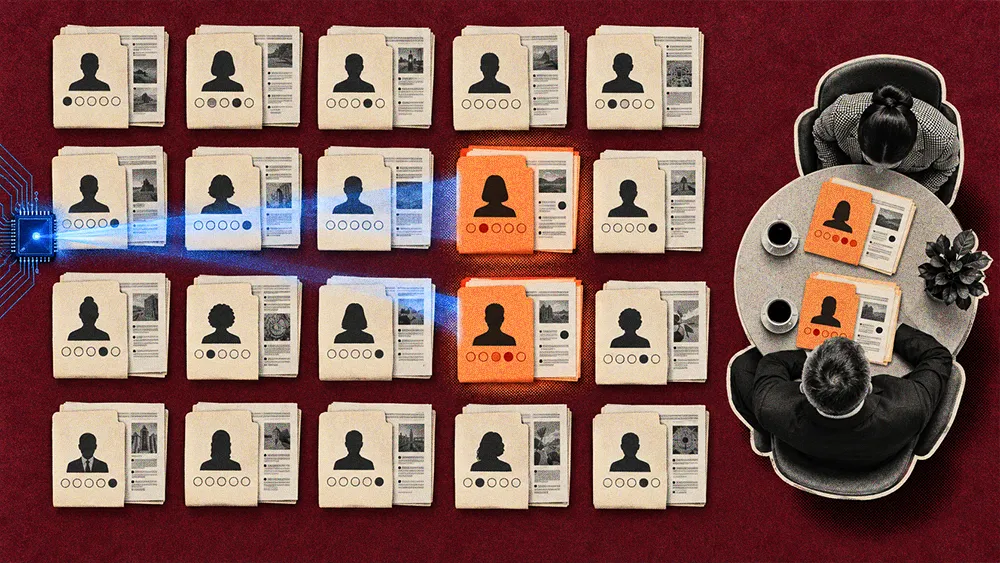


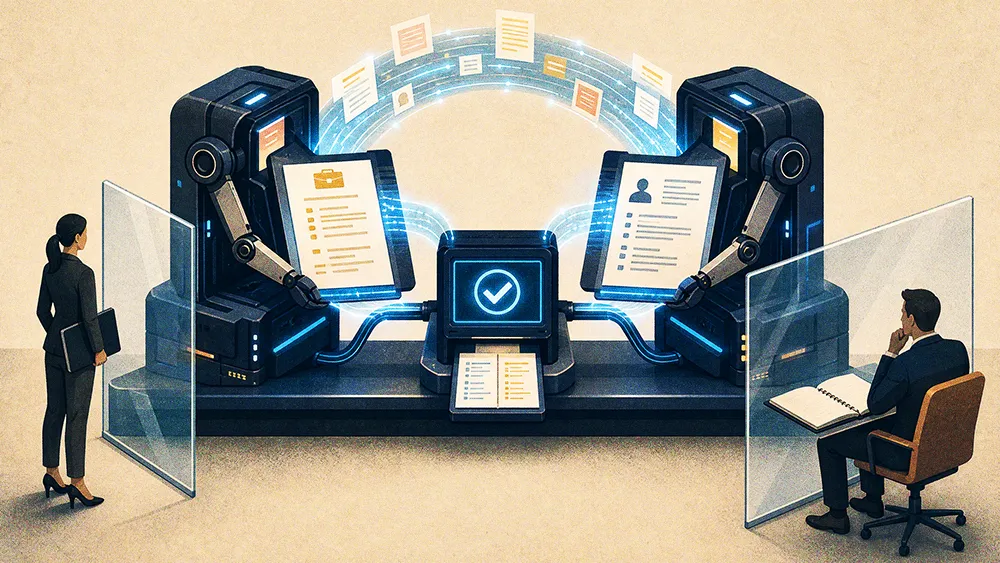
Consider the modern journey of a job application. A candidate pastes the posting into a resume-tailoring tool, which rewrites their history to mirror the description's exact phrasing. The description itself was drafted by AI; among teams using AI in recruiting, 66 percent use it to write job descriptions, the single most common use. The tailored resume then lands in an applicant tracking system where, per SHRM's research, 64 percent of HR professionals say AI automatically filters out candidates judged unqualified.
No human is in the loop
Trace the information flow. Software wrote the question; software wrote the answer; software graded the answer against the question. At no point in this loop did a human learn anything about another human. The resume screen has become an exchange between language models, with the candidate and the recruiter reduced to spectators of their own negotiation.
The advice industry has adapted with impressive speed and little self-awareness. Career coaches now instruct applicants to keep formatting simple so the parser can read it, to mirror the posting's exact phrases, and to avoid tables and graphics that might confuse the machine. Note what this advice optimizes for. It optimizes for legibility to a filter, not clarity for a human reader. An entire genre of professional guidance now teaches people how to be parsed.
The volume spiral keeps feeding itself. AI tools let a candidate apply to dozens of roles in the time one application used to take, so application counts explode, so employers automate harder, so candidates automate harder in response. Job seekers describe sending resumes into a void, and they are close to literally correct, except the void has a parser. Meanwhile, the candidates with the most options exit the loop entirely, landing roles through referrals and direct outreach, which means the automated funnel increasingly selects from the pool of people the automated funnel has already exhausted.
Everyone behaved sensibly. The signal died anyway.
Employers should resist the urge to feel superior here because they built the arms race. Automated filtering answered a real problem of application volume. AI-tailored applications answered the filtering. And the resulting flood of optimized, interchangeable resumes is what candidates produce when a system rewards keyword conformity over anything true.
Strip the loop down and ask what a passing resume actually proves. A keyword-matched resume demonstrates exactly one skill: producing a keyword-matched resume. That skill correlates with access to the right tools and knowledge of the game, which correlate with privilege more reliably than with talent. The candidate best at the job, and the candidate whose resume best mirrors the posting, were rarely the same person to begin with. Now that mirroring is automated, they are the same person essentially at random.
Breaking the loop
Escaping the cycle requires changing what gets measured. Information that a machine cannot generate on a candidate's behalf, demonstrated ability, measured under conditions that verify who is doing the demonstrating, is the only input that breaks the pattern. Everything else is prose, and prose is now free.
The resume was a compression format: a life, reduced to a page, for a human to read in thirty seconds. No humans are reading. The page is machine-written. It may be time to admit the format has outlived both of its assumptions.