

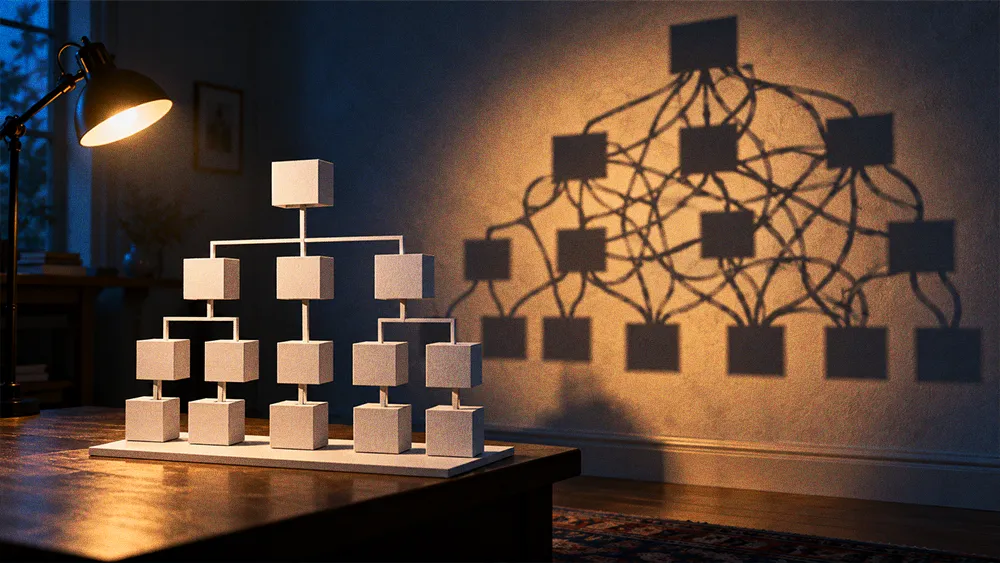
You have the formal org chart, the one on paper, and then you have a shadow org chart where decisions are made, recommended, and advised. It's really that informal network that you need to capture.
 Philippe BernimolinGlobal Talent Acquisition & Transformation Executive
Today's hiring teams are being asked to get more out of the workforce they already have. Criteria's 2026-2027 Hiring Benchmark Report has 52% of hiring professionals reporting their work as harder than a year ago, ranking upskilling current employees alongside hiring efficiency as the top priority for the year ahead. Those plans get built from an org chart that sets out who reports to whom, but leaves out the path a decision takes on its way to being made. Reorganizations redraw those reporting lines routinely, but the relationships inside the old ones often get lost in the exercise.
Philippe Bernimolin is a talent acquisition and transformation executive, most recently Head of Global Talent Acquisition Operations at Worldline, the international payments company. There, Philippe ran a global team of talent acquisition professionals and led the evolution of the function from RPO-supported delivery to a fully in-house model, and from a country-driven structure to a centralized one built around a talent acquisition center of excellence. Additionally, he previously led talent acquisition across 26 countries in EMEA for Solvay and global talent acquisition for Pall Corporation's Life Sciences units.
"You have the formal org chart, the one on paper, and then you have a shadow org chart where decisions are made, recommended, and advised. It's really that informal network that you need to capture," says Philippe. In a recent article, Philippe named the continuity gap, where the reasoning behind a structural decision goes unrecorded and leaves with the people who held it. Organizational network analysis is one way some companies already map that informal layer.
Starting from scratch
Across his career, Philippe has seen the team assigned to a new organizational project rarely receive the findings of the one before it. He describes one case where two consulting teams brought in a couple of years apart for the same project reached different conclusions, and neither told what the other had tried. He has also seen three CHROs rebuild workforce planning over four years, each starting from scratch. "I've been noticing the same pattern throughout my career, happening again and again. A structure that was built carefully over years gets reversed only a few weeks after the person that built it left the company," he notes.
Philippe has watched companies bring in major consulting firms to design a new structure, but spend nothing on keeping a record of why or how the last one was drafted. "They are not investing enough in preserving the why, the reasoning behind the decision," he explains. "That's where the issue comes from."
The transitional space between roles
When an employee leaves a role, their replacement usually gets a few weeks alongside them first. Philippe has been on both sides of that, joining new roles himself and taking part in the same sessions with employees who reported to him. What transfers in those weeks is the task list. "It's mainly a conversation between two people. You never get the complete picture," says Bernimolin. "Most of the time you realize weeks or months later, when the person that left is no longer reachable."
Philippe says the cost typically shows up months after a reorganization. Two employees both think a decision is theirs to make, so it waits. A project gets redone because the employee who knew why it was built that way has moved on. "What is missing here is the connection to the bigger picture of how decisions flow through the company," he adds. "And that gap stays invisible until it's too late."
A record that follows the role
Philippe advises making that record a standing assignment: write down why each structural decision was taken. A new leader can reverse such a decision later and still have the reasons in front of them. "There should be someone somewhere keeping track of why a decision was taken. Not the decision itself, but the reasoning, the context of why the decision was taken," says Bernimolin. "That record should follow the role, not the person."
Philippe suggests one record keeper in every department. He says companies often plan for a leader's departure but overlook the colleagues everyone consults before a decision is made. In his experience, constant restructuring has become business as usual, and keeping pace with it is difficult. "I think that's the tricky part, making sure that those guys do not walk out the door with the why, with the context," Philippe notes.
Redrawing an org chart is the easy part, and Philippe says the informal network decides whether the new structure works. Instead of recommending a software program, he advises organizations to simply master the discipline of writing things down. "If I had one thing to tell a leader, it's perhaps not only to focus on the new design, but also to reflect a bit more on what was already working well with the old one," he concludes.