


We emphasize measuring not what someone knows the day you hire them, but their potential: what they can learn and how they can grow.
 Josh MilletFounder and CEO @ Criteria
The job an employee is hired to do today is unlikely to be the same job two years from now. Descriptions get rewritten, tools change under people's feet, and whole categories of work migrate into software. In that environment, the most valuable thing an employer can know about a candidate isn't the record of what they've already done, but the rate at which they can learn what comes next. Most of the instruments hiring still leans on point the other way. The resume, the degree, and the quick read on whether an interviewer clicks with someone all measure the past or the irrelevant. The signal that keeps predicting performance as the work itself changes is a person's capacity to adapt and grow.
Founder and CEO Josh Millet built Criteria on this very principle. The talent assessment company, which he started in 2006, puts science-based hiring tools within reach for organizations of any size. Millet arrived at the problem by an unusual route, holding a Ph.D. in history from Harvard, where he was a Fulbright Scholar, before startups and education technology pulled him toward hiring. Two decades of building assessments have left him with a conviction about where employers should be aiming their attention, and it's not at the record a candidate hands them.
"We emphasize measuring not what someone knows the day you hire them, but their potential: what they can learn and how they can grow," he says. It's a simple reframe, and most of the traditional hiring process still runs against it.
The resume only points backward
Millet's distrust of the resume is both professional and personal. "The first thing you learn in history grad school is never trust a primary source where the author is the hero of their own story," he says. "That's exactly what a resume is."
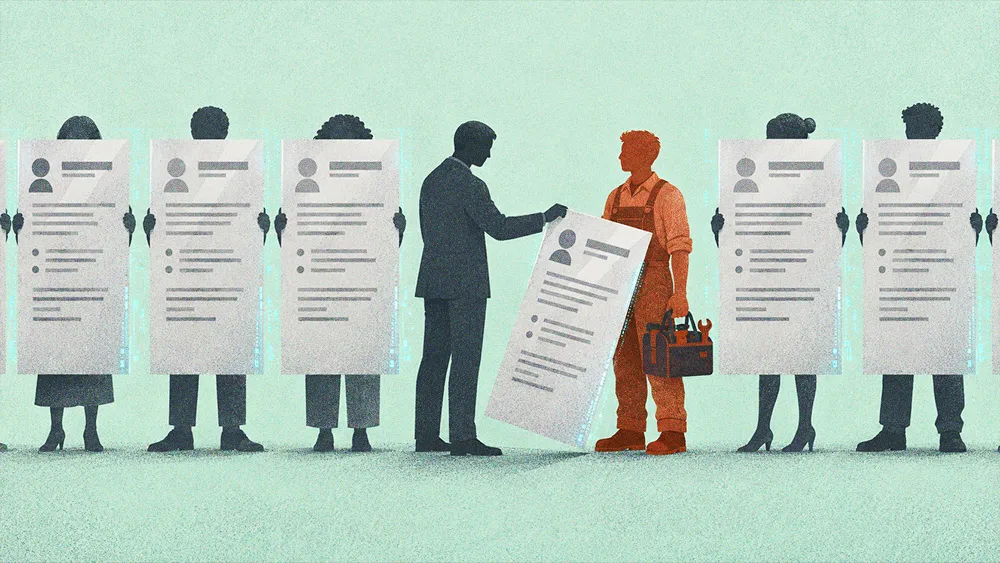
Even setting self-authorship aside, the document is assembled entirely from what a candidate has already done, which he considers a poor basis for predicting what they'll do next. Statisticians would call it a weak signal, and generative AI has made it weaker. When every applicant runs their resume through a chatbot, the pile arrives polished into sameness, and the hiring leaders Millet talks to describe opening one indistinguishable file after another. "I talk to HR people every day and they're saying, 'What do I do with this undifferentiated mass of resumes?'"
What they reach for when the documents blur together is revealing. Everyone endorses skills-based hiring in principle, he notes, yet faced with a stack of identical resumes they still fall back on the familiar marker, like the selective school or the recognizable former employer, and hire the brand.
The skills we call soft are the ones that last
If the resume is the wrong place to look, Millet is specific about the right one. The qualities that hold up as work changes are the ones the field has saddled with a shrinking label. "Some people call them soft skills. I hate that term, because to me they're a lot more meaningful than hard skills," he asserts.
Critical thinking, problem solving, judgment, emotional intelligence, and the speed at which someone learns and applies what they learn are, in his account, what drive long-term performance, and they matter more as AI absorbs the routine tasks a job used to be built from.
He offers his own engineers as evidence. A few years ago, twelve of them rebuilt Criteria's platform in React, a language none of them knew when they were hired. Had the company screened on the languages candidates already had, that knowledge would've expired within two years. "Instead we hired smart people who were good learners, who were intellectually curious. They learned these new languages as they came along." Even in a technical, well-paid role, he says, the ability to keep learning now counts for more than any fixed credential.
The beer test measures the wrong thing
The harder problem, in Millet's view, is getting human interviewers to stop measuring something innately human. The science of what works in an interview is fairly settled: consistent, job-relevant questions, scored rigorously, outperform a free-flowing conversation, yet most interviews still turn on rapport. "That is predictive of whether I would like to have a beer with you, but that should not be the standard for whether I hire you," Millet says.
The pull is strong because the verdict lands so early. He points to research showing that a large share of interviewers decide whether a candidate fits within the first five minutes, before any substantive discussion of the job has taken place. What fills those minutes is small talk, a shared hometown or easy chemistry, none of which forecasts how someone will perform. "We've got to uncoach that habit," he says.
A structured interview helps. Take away the incidental connection, and what's left is whether the person can do the role.
Credentials that move with the person
The same logic reshapes how Millet treats credentials, which he sorts rather than dismisses. A credential merely vouches for someone, but the more important question is what it certifies. A degree is what he calls a static credential. "That static credential that you graduated with from a certain school is just a moment in time. It shows that you did enough in those four years to get in and get out, but it's not something that evolves as a human does." Static credentials also contribute to opportunity gaps, since many capable people never had access to the degree to begin with.
As job descriptions and whole job categories turn over faster, he expects the weight to shift toward dynamic credentials, which are evidence of ability that updates as a person develops. An assessment of how someone learns is one example, because it travels across roles and holds its predictive power as the work changes. "I think we're going to look more and more for dynamic credentials versus static ones," he shares.
The distinction he ultimately draws is between a snapshot and a trajectory. One tells an employer where a candidate has been, while the other gives a reasonable read on where they can go. The faster a job changes, the more that forward read is worth. For all the change he describes, Millet's advice to the people doing the hiring is straightforward. "The one constant is that set of durable skills that speak to adaptability, growth trajectory, and growth in general," he says. "That's the most reliable anchor I see."