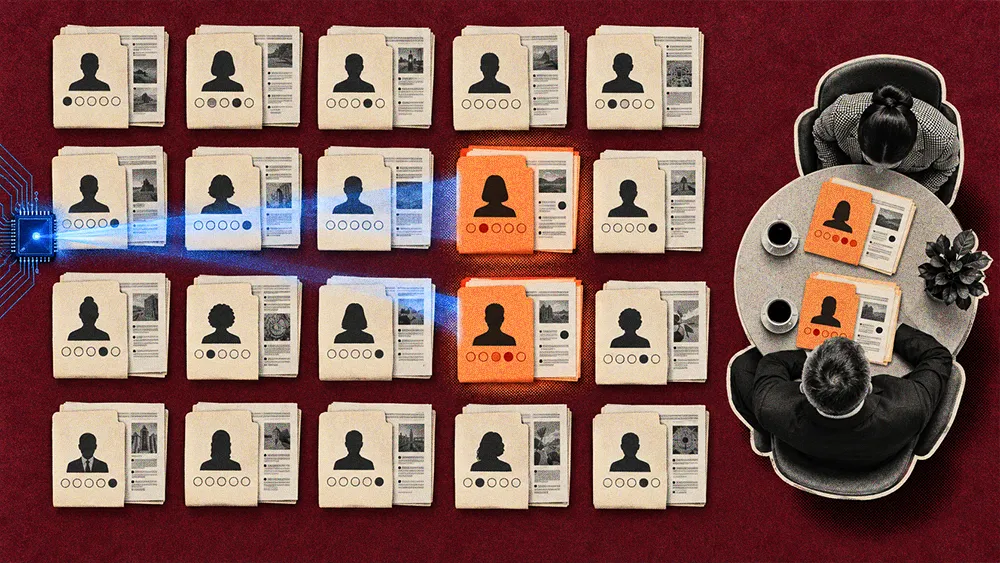


Wes Ward leads artificial intelligence at Ken Garff Automotive Group, a 70-rooftop car dealer group, and lately he's been hiring for his own team. The resumes arrive perfectly tailored to the job description, flawlessly formatted, keyword optimized, and, in his words, identical. "Not similar. Identical," he wrote on LinkedIn. "You can almost see the prompt that generated it." What bothers him isn't the polish but what it buries. "I can't tell where the resume ends, and the person begins."
He's hiring for AI positions, so his candidates lean on the technology harder than almost anyone, and the result is a cruel sorting problem where "the people who most need to stand out are the most invisible," he wrote. The screening tools can't rescue him either, because when every applicant feeds the same job description into the same models, the outputs come back nearly indistinguishable, and software ranks a stack of near-duplicates into an order that means very little. "I don't know what the solution is yet."
Ward is a hiring manager, not a recruiter, but the stack on his desk is the one talent teams have been staring at all year. What he saw in it is the same thing recruiters now describe across nearly every high-volume opening. A single posting can draw hundreds of applications in a day, most of them competent, formatted, and hollow in the same way. Volume broke first, and authenticity broke right behind it, because the same tool that lets a candidate apply to sixty jobs before lunch also makes all sixty applications read as one person wrote them, which is to say as no person did.
The detection trap
The tempting response is to treat this as a cheating problem and go hunting for the AI, screening out anyone whose writing looks machine-assisted or adding a line to the posting that forbids it. That fails on contact with reality. Detection is unreliable; the honest applicant who ran a draft through a spell-checker gets flagged next to the one who auto-generated everything, and, as Ward's own stack shows, often you can't tell at all. Policing how a resume got written also aims at the wrong target. Nobody was ever going to hire the resume. The exercise was always about finding the person behind it, and that person is exactly what the paper has stopped revealing.
The resume was always weak
That points at an older problem, one that predates any chatbot. The resume was always a weak signal. It's a self-reported document, formatted by the candidate to flatter the candidate, and the screen was only ever a proxy for skill, a bet that the right keywords and the right years lined up with someone who could do the work. AI exposed the weakness rather than creating it, by making a flawless version trivial to produce. When every resume is perfect, perfect stops carrying information, and a signal that was thin to begin with falls to zero.
Making candidates show the work
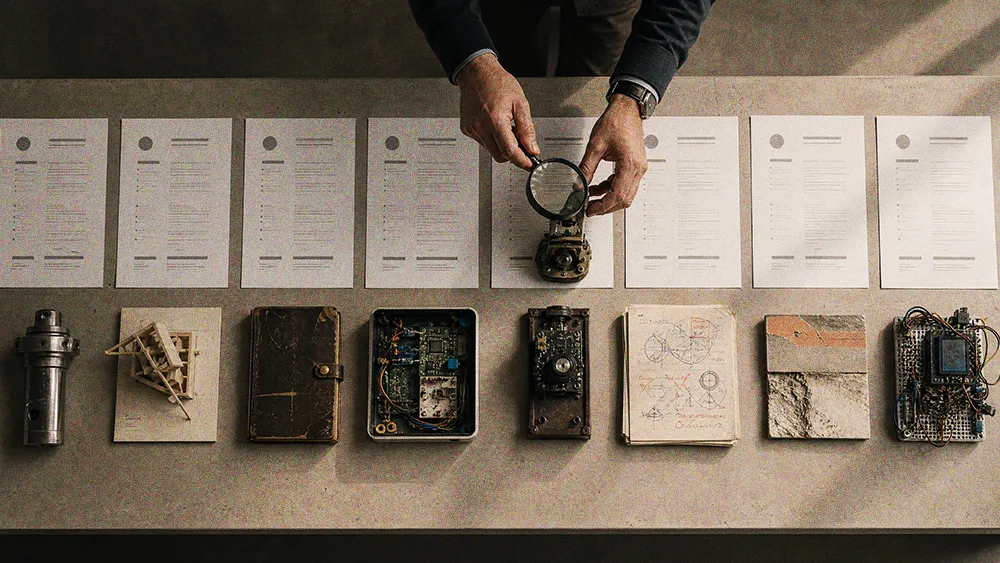
The move left is to stop treating a document as proof and start asking candidates to show the work. A short, real task tied to the actual job, a work sample scored the same way for every applicant, does what a resume no longer can. Someone who can actually do the work demonstrates it the moment you ask, and someone who only knew how to prompt their way to a clean PDF reveals that just as fast. The evidence moves off the page and onto something a real person has to perform in front of you.
Ward ends without a fix, and with a sentence that reads like one. "The most valuable signal in an AI hiring process is the evidence of an actual human," he wrote. After a year of perfect resumes, it's the only signal left worth measuring.