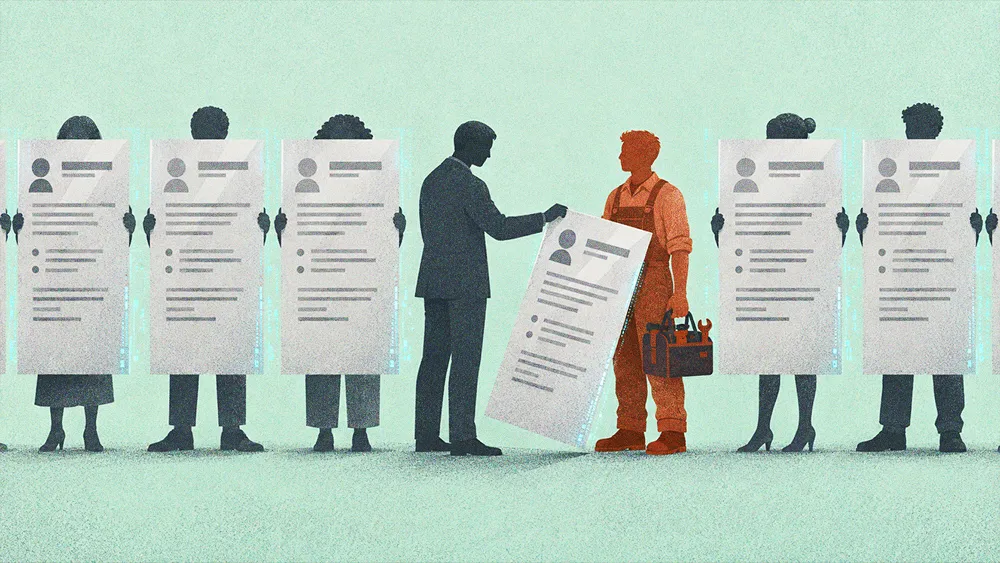



If you pull out some of those middle layers, where does the work go? That's what companies are really trying to design, to leverage more technology and to change the systems so that people are empowered to be able to deliver.
 Stephanie CrookPrincipal @ PKC Group
Enterprises are now auditing and removing layers of management, moving more decisions closer to where work actually happens. Recent survey data puts the share of employees whose company cut a layer of management in the past year at 41%, with speed as the reason most often given. The structural change is the faster half of the exercise. Redistributing the responsibilities that layer held, and building the capability to absorb them, is what takes time and effort.
Stephanie Crook is Principal at PKC Group, where she advises executives and their leadership teams. She was previously Vice President, Org and Talent Capability at Intel where she advised the CEO and executive leadership on people strategy, operating-model transformation, workforce capability, leadership development, and culture. Earlier at Intel, as Vice President, HR Strategy and Culture, she built the company's Workforce of the Future strategy. Crook has worked in talent and organizational capability for more than 25 years, and also previously served as a senior organizational effectiveness consultant at Blue Shield of California.
"If you pull out some of those middle layers, where does the work go? That's what companies are really trying to design, to leverage more technology and to change the systems so that people are empowered to be able to deliver. They're less reliant on the manager to tell them what to do and more reliant on the manager to help them navigate the organization," says Crook. Today, she works on that design question with executive teams, and says she doesn't know one organization that hasn't either made deep cuts to its management layers or at least started thinking about it. The managers who remain are the ones who have to make the new structure work.
Designing where work goes
Learning cycles, product cycles, and competitive pressure are all moving faster, and Crook puts technology behind the acceleration. Each layer adds time to a decision, and they also blunt the individual accountability that makes an employee feel ownership of the work. Part of a manager's traditional value was passing information up, down, and across, which software now often handles. The way companies rank a manager's job hasn't changed as quickly. "Historically we've leveled jobs against scope, so we've said, 'How many people do you manage? What's your budget?' That is old school," says Crook. "Now you really look at a role based off of impact and how fast those managers can move, capabilities the organization cares about."
Crook describes the middle as the layer under the most pressure, and the one companies remove first when they move to leaner teams. Removing it raises the question of where its responsibilities go. What companies are designing in its place is more technology, along with systems that let employees move work forward without waiting to be told. The manager's part in that design is helping employees find their way through the organization instead of assigning their tasks. "The middle manager role is really, really difficult because they don't have the ability to necessarily call what the strategy is, but they have all the accountability to execute it. And so there's a lot of pressure in the middle," says Crook.
Reading for the wider scope
Crook says companies don't assess who can run the wider scope as well as they could, and tend to rely on who performed well in the old structure. The managers who hold up in the new one are usually comfortable with ambiguity, proactive, curious, and willing to use AI tools to scale their own work. Emotional intelligence counts for more as well, since more of a manager's week runs through relationships. Simplification is what Crook coaches more than anything else, reducing something complicated to a version a team can act on. "I cannot tell you how much work I do with executives and leaders to help them just simplify the complex," she says. "The best companies know how to simplify so people can focus on the right things and they can then execute at scale and speed."
A manager promoted for technical strength can prove far less effective at integrating people. Crook says some companies now separate the roles that lead projects from the roles that lead people, and design each one differently. Determining which of the two a manager is suited to takes time that a reorganization rarely allows. At Intel, Crook worked on a redesign of the company's job levels, the internal rungs that grade a role's seniority and set its pay band. The number of levels came down by roughly half within weeks. She says the design work was the manageable part, especially at a company that has already agreed what good looks like in the role. "Most companies want to make those changes so rapidly that they're not really doing the work to say, 'Well, is this person a great person to keep or not, or should they be pivoted to a different job?'" says Crook.
Growth without a new title
Taking out layers changes what a promotion means, and Crook says everything attached to it has to move at the same time. An employee now has to be able to advance in place, meaning moving inside a level instead of stepping to the next one. In Crook's experience, companies doing this are settling at five or six levels in total and letting senior individual contributors lead work without a title change. "Companies have to reshape how they do their compensation, their leveling frameworks, all of the rewards process, how they do bonuses," she explains. "Because the band is so large and the rewards continue to be there as you're more responsible and you have more impact, you don't need to be promoted to a new level."
Inside those companies, Crook says employees talk about the project they're on more than the title they hold, and the title does most of its work outside the company. What the employee weighs is the work itself, the accountability that comes with it, the authority to run it, and the compensation. Crook says a manager still has to be able to do the work in order to coach it. Learning the tools the team is expected to use is part of the same job. "I don't know any expectations that I really value that don't include modeling the values of the company. That will never change because culture drives execution," Crook concludes. "If technology is paramount and required for the company to be able to compete, then managers have to model that."