
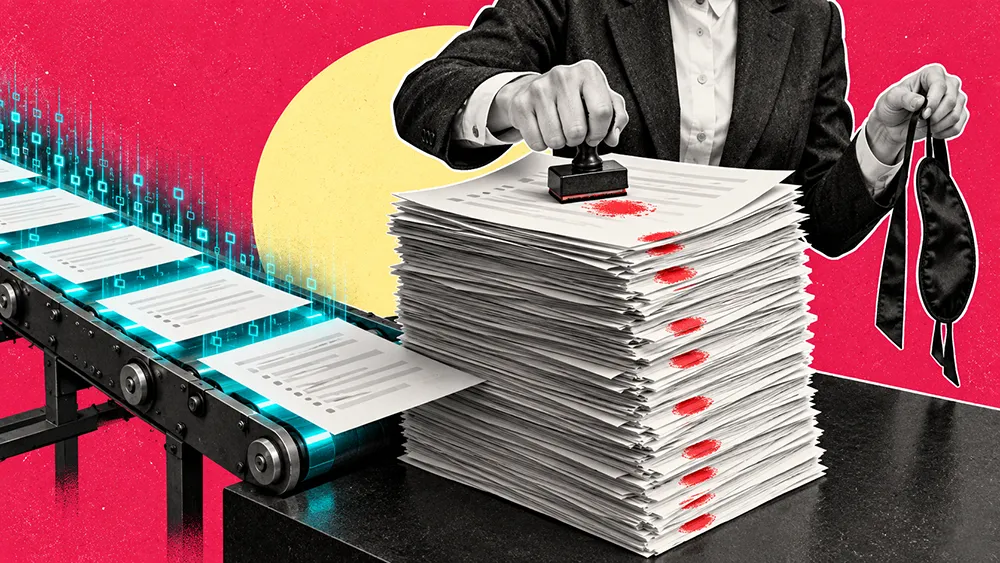

Recruiters are just rubber stamping. They’re manually clicking reject, but they’ve never looked at those resumes.
 Bill LandryTalent Acquisition Consultant, Excel Resources
A posting for a competitive role can draw 300 applicants in 48 hours, and a growing share of them are bots or candidate-side agents applying around the clock. A recruiter who asks an AI tool for the 30 best matches gets an answer in seconds, but the other 270 candidates never reach a human reader, and in jurisdictions with hiring-AI rules that gap is where the legal exposure sits. The shortcut feels safe because a person still clicks reject. Without a real review behind that click, the employer can end up carrying the exposure of full automation with none of the protection that human oversight is meant to provide.
Bill Landry, Independent Talent Acquisition Consultant at Excel Resources, spent a decade at HERE Technologies leading global talent acquisition projects across the Americas, EMEA, and APAC at roughly 1,000 hires a year. He previously built the recruiting function at Cleversafe from a one-person operation into a team that supported growth to nearly 300 employees before IBM acquired the company in 2015 for a reported $1.3 billion. He now helps teams adopt AI hiring tools while staying compliant with Illinois, California, New York City, and EU requirements. His starting point is the recruiter's desk, where the volume that pushes teams toward AI also makes compliance hard to practice.
"The whole reason for using AI is to not have to take the time to go through the other 270," Landry says. Rules written for automated tools assume somebody reviewed the output, which leaves recruiters between a pile they can't read and a standard that presumes they did. His remedy is a short list of inexpensive habits, and the pressure behind the shortcut explains why so many teams skip them.
Volume pushes recruiters toward AI shortcuts
Candidates have their own AI now. Landry points to agents that apply to jobs overnight, fake applicants, and prompt injection hidden in resumes, all arriving in the same queue as legitimate candidates. Recruiters are "just trying to put out the fire in terms of volume of candidates" he says, and AI is the quickest tool within reach.
Criteria's 2026-2027 Hiring Benchmark Report, which surveyed more than 1,000 hiring professionals, found that 56% already use AI in hiring and 46% use it to screen candidates. Landry's article notes that many teams brought their tools in without rules for when to use them, because leadership asked everyone to start using AI before anyone wrote guidance.
Landry says vendors often sell their tools on the premise that a person makes the final call, since nothing is rejected until a recruiter clicks the button. A recruiter who works through the top 30, interviews 10 strong candidates, and moves them forward has little reason to open the rest. On the ground, "recruiters are just rubber stamping," he says. "They're manually clicking reject, but they've never looked at those resumes."
His article says meaningful human oversight requires a reviewer with the authority and the time to overrule the tool, and in the UK, he notes, clicking "confirm" on a list nobody examined doesn't count. A reject click on resumes no one opened meets neither condition.
New York has the strictest US rules, and other states are adding their own
What that gap costs depends on the jurisdiction. No national AI hiring law exists, so employers work with a patchwork, and New York City's Local Law 144 is its strictest piece. An employer using an automated employment decision tool needs an annual bias audit by an outside firm, has to publish the results, and must notify candidates at least ten business days before it starts using the tool. Landry's article adds that each day an unaudited tool stays in use counts as a separate violation. The risk today is "probably not super high," he says, but "it could be expensive, especially in New York, because if you're using a tool and you haven't done the audit, every day you use the tool is another infraction."
Where a company hires decides which rules apply, and a remote posting open across the country can bring several jurisdictions in at once. Illinois has required employers to notify candidates when AI influences or facilitates a hiring decision since January 2026. Enforcement has lagged, and many companies are "trying to fly under the radar," Landry says. Federal policy has moved toward less AI regulation, and Colorado has replaced its AI Act with lighter rules slated for January 2027. That softening can mislead teams, his article warns, because the rules have loosened while the lawsuits have multiplied.
Existing discrimination law already covers the outcome
The lawsuits rest on statutes that predate AI. Title VII, the ADEA, and the ADA apply to hiring decisions whether a person or a tool made them, and a claim can rest on results with no proof of intent. "If the outcome is someone was discriminated because of the tool, you're liable," Landry says.
The case he returns to is Mobley v. Workday, in which Derek Mobley alleges he applied to more than 100 jobs through the Workday platform and was rejected each time, often within a few hours and at odd times outside business hours. The court has let the case proceed and preliminarily certified an age discrimination collective action in 2025. Landry points to the judge's 2024 ruling that let claims proceed on the theory that Workday acted as the employers' agent, which matters because anti-discrimination law reaches an employer's agents. The vendor's exposure doesn't lift the employer's, though, and his article puts it directly: "'The algorithm did it' isn't a defense. Neither is 'we bought it that way.'"
Binary criteria and a sample of rejected resumes narrow the risk
Landry's first recommendation is to limit AI screening to yes-or-no questions, such as three or more years of a specific skill or eligibility to work in the United States. Scoring vocabulary, prose, or writing quality invites bias, because "different people, different education levels, they would use different words," and he says studies have shown different races do as well. "There's a lot of ways that you could be discriminatory and not even realize it just by looking at the text," he says.
His second recommendation addresses the 270. After the tool produces its top 30, a script can add about 10 candidates the AI ruled out, or two recruiters can swap lists and add random rejected resumes to each other's. If one of the added candidates looks strong, the team has found a flaw in the algorithm, and the exercise leaves a record that the company checked. Landry hasn't seen this practiced widely and expects ATS vendors to start building it. "It's not necessarily a cure all, but it would be a great defense if you were to be sued that we're trying our best," he says.
Training recruiters on AI limits is the first move
Of the seven actions in his article, Landry names training as the one every company should start with. In his conversations with TA leaders, "very few of them have any structured training of their recruiters on TA tools." The EU AI Act already obliges employers to support AI literacy among staff who use these systems, and his reasoning applies anywhere, since recruiters who know where the tools fail make better calls on when to override them. "If you've ever used Claude or ChatGPT, it can be amazingly brilliant one minute and then completely wrong the next," he says.
The worry is already widespread. In the Hiring Benchmark report, 26% of hiring professionals named bias and fairness among their biggest concerns with using AI in hiring, and 21% named legal and compliance risk. Training answers both inexpensively and supports every other step, since a sampling check or a binary filter only works when the recruiter running it understands why it's there. His article covers the other six actions.
Tools bought and processes designed this year will still be running when enforcement catches up, which makes compliance a design decision at purchase time. For TA leaders weighing a new screening tool, the useful test comes from what a regulator or plaintiff would ask later, namely who reviewed the candidates the tool set aside and what the company can show for it. "You don't want to build a whole new process that's non-compliant that you're going to be using next year when more and more of these compliance laws start to take effect," Landry says.