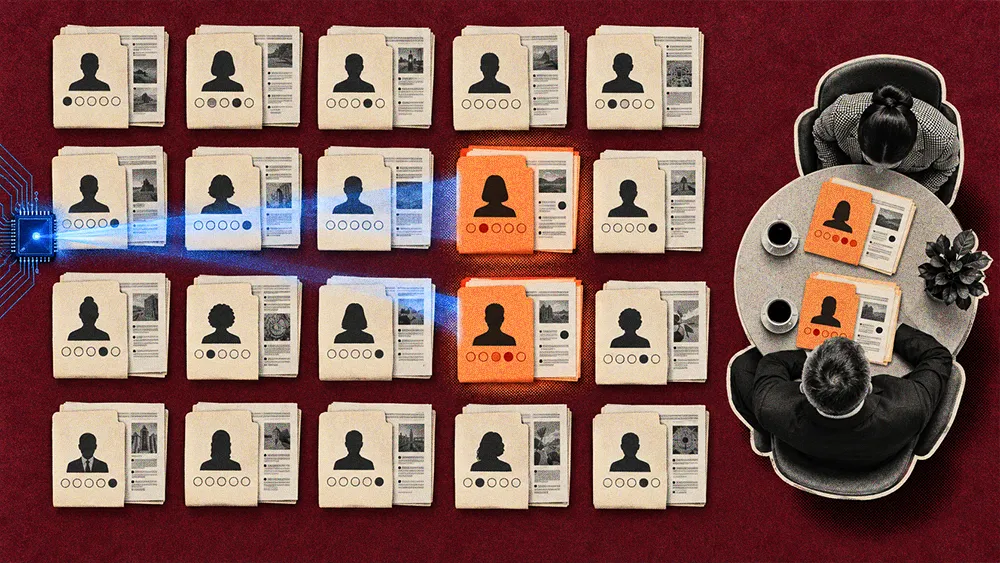


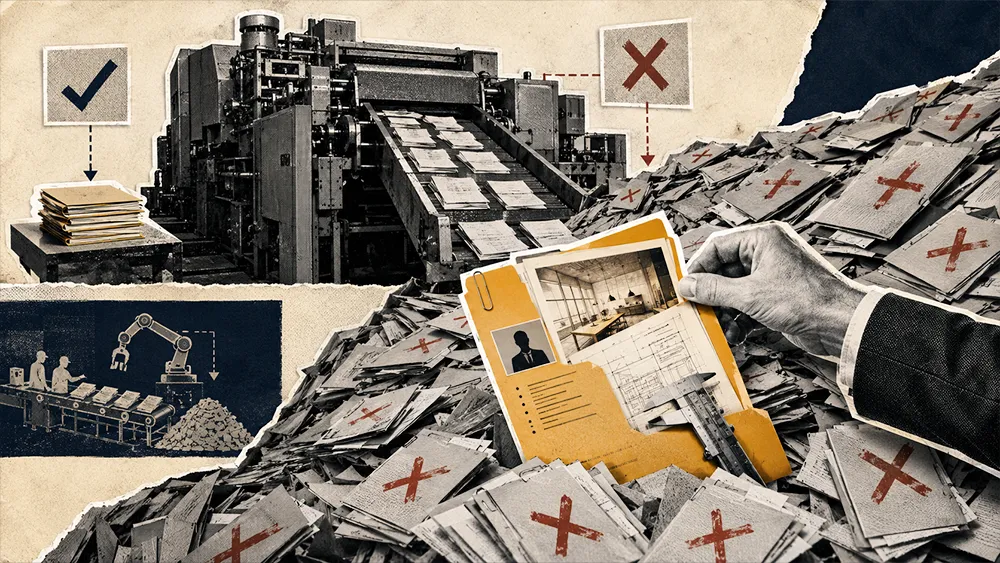
AI rewards candidates/agencies who know how to optimize resumes for bots and penalizes candidates whose sole focus is on doing great work.
 Ares CerrerHead of Talent @ Outwitly Inc.
An automated screening tool rejected one of Ares Cerrer's clients' own proven contractors, someone already succeeding in the exact role the client was trying to fill. Cerrer, Head of Talent at Outwitly Inc., a service-design consultancy where he's spent close to 15 years working in talent acquisition, wrote on LinkedIn that the filter "completely overlooked an internal champion who already knew the culture, the systems, and the stakeholders." This was a known quantity, doing the work, and the software cut them anyway.
Most teams would call this one bad tool, or one bad configuration, a bug to patch and move on.
What the filter actually rewards
Applications arrive faster than any team can read them by hand, and generative AI has made them cheaper to produce by the day. No recruiter clears that pile unaided. The filter is the only way through the volume. The problem is what the automation learned to reward.
Cerrer puts the blame on what the filter measures. He wrote that "AI rewards candidates/agencies who know how to optimize resumes for bots and penalizes candidates whose sole focus is on doing great work." A screener tuned on keywords and formatting measures whether a document was built to please it. The proven contractor's resume wasn't groomed for the parser, because the contractor was busy being good at the work. The people optimizing hardest for the filter often have the least to show for it, and the people with the most to show are the least likely to be gaming a format.
The documented default
This runs well past one consultancy's unlucky anecdote. Ninety percent of US employers now run AI screening tools, and most lean on the same handful of vendors, which turns one model's blind spot into an industry's. Stanford researchers tracked 4 million applications from 3.4 million people across 150 employers and 11 sectors, every one screened by a single third-party system, in the first large-scale look inside hiring algorithms running in production. Ten percent of applicants who submitted four applications were rejected from all four, a rate higher than independent decisions would produce. The same people get turned away everywhere because the same model is reading them everywhere. A filter turning away people who can do the job is the documented default whenever nobody checks what the machine discards.
Where the human sits
Cerrer's fix leaves the AI in place. "AI is a powerful co-pilot for handling high-volume logistics, but it is a terrible solo captain," he wrote. The difference is where the human sits. As a co-pilot, the model does the part it's genuinely good at, sorting thousands of applications no team could triage in a day. As a captain, it makes the irreversible call, the rejection nobody reads, on candidates it was never built to evaluate. Handing the model the sorting is sensible. Handing it the verdict is where good hires disappear.
The repair is procedural before it's technical. His rule for anyone screening at volume is that "you must build in human fail-safes to audit the rejections." Pull a sample off the no pile and have a person read it. The rejections are where the failures hide, and they're the one output almost no team ever inspects. "Otherwise, you aren't optimizing your pipeline; you are just automating your blind spots. He closes with the line worth pinning above the pipeline: " A screener you never audit can't tell you who your best candidate is. It can only tell you who wrote the best resume for a robot.