

We're not actually looking for a 'right' answer, but more so, how does this person think on the fly? If all of the AI just went away tomorrow, could they still do it?
 Christin MarshallSenior TA Specialist, Babylist
Hiring teams have spent the last two years learning that the resume is noise. A document that can be reverse-engineered against a job description in seconds stopped carrying real signal, so most talent functions have been leaning harder on the conversation that follows. Live AI assistance is putting those conversations under pressure, too. When a candidate can run a live AI assistant during a screen, having answers fed to them in real time, the interview becomes one more surface to optimize rather than a window into how a person thinks. That puts more weight on evidence beyond a polished answer, including assessments, work samples, and structured follow-up questions.
Christin Marshall is Senior Talent Acquisition Specialist on the TA Operations team at Babylist, where she's been tracking how candidate behavior shifts at the top of the funnel. Her team screens for roles across the organization, which gives her a volume view of a pattern most recruiters are only starting to name: the interview itself has become a contest between the tools on both sides of the call.
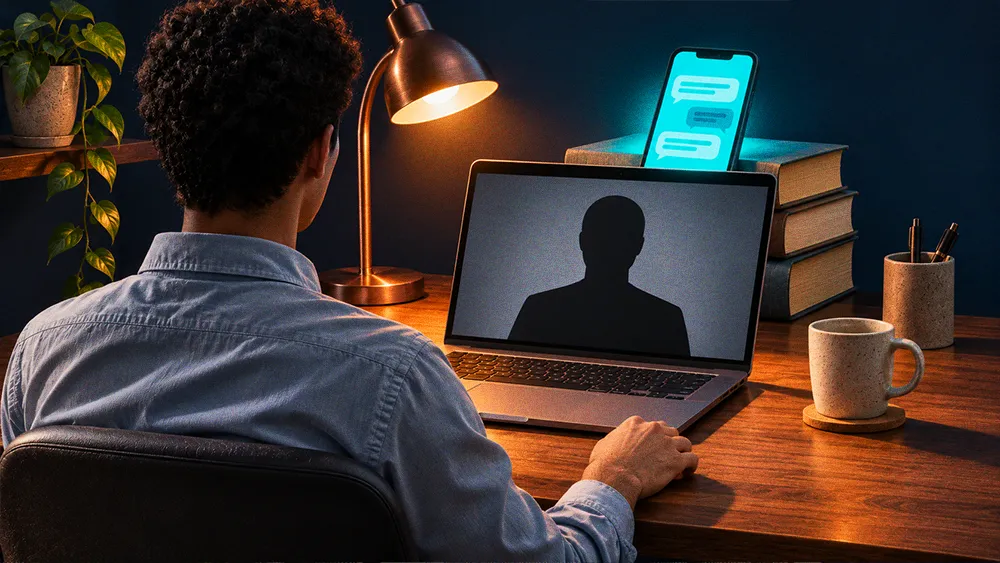
Marshall says follow-up questions have prompted her team to look more closely at whether candidates are relying on live AI assistance. "My team will ask a follow-up question and it struggles with that. The candidate will say 'Oh, can you repeat that again?' or 'Hold on, my connection is breaking up.' In the background you can literally hear the computer keys tapping," she shares. Marshall is careful to separate preparation from substitution. Rehearsing with AI against likely questions is expected and fine. The problem is the candidate who outsources the thinking in the moment.
Polish was never the thing worth screening for
The deeper issue is the gap between a polished application and demonstrated ability. A resume optimized against the posting can look strong to an automated resume matcher without showing how the candidate would perform the work. "Their resume is really polished, so our different AI talent matching tools or screening tools say, 'This looks good,'" Marshall says. "But then we talk to them and realize it's not as great as it seems because they're letting AI think for them instead of supporting their thoughts."
Her team treats the gap as a feature of the system working, not failing. "Our systems don't necessarily screen for polish. If it did, there would be something broken." In her view, polish is what AI is best at manufacturing, so a process that rewards it is selecting for the wrong thing. The question is what to measure instead.
Live work sessions add evidence to the interview
Marshall points to live work sessions as one way to see candidates explain and apply their thinking. In the approaches she describes, the structured interview includes a working session that makes the reasoning behind an answer visible. "A lot of organizations are starting to do skills-based interviews now, where it starts off with STAR-based questions and then turns into a live working session. We're not actually looking for a 'right' answer, but more so, how does this person think on the fly? If all of the AI just went away tomorrow, could they still do it?" The useful distinction is whether candidates can explain their own reasoning and contribution. Clear expectations about permitted AI use help interviewers evaluate that contribution alongside the finished work.
The design is role-dependent. "Almost every single role will have a case study or a presentation, and those are done live," Marshall explains. "For more junior roles, we might do a take-home assignment where there are different scenarios." These formats can complement assessments and structured interviews, with the task and evaluation criteria matched to the role.
The shift is showing up in the research. In Criteria's 2026-2027 Hiring Benchmark Report, which surveyed more than 1,000 hiring professionals, 24% said they've lost confidence in resumes as a reliable signal. More than a third said their process can't reliably detect when a candidate is using AI to misrepresent themselves. The volume making that worse is real. Job seekers are sending 30% more applications than before the pandemic, according to LinkedIn's CEO, and it's gotten harder to know who can actually do the job. When self-reported inputs degrade at that rate, the weight moves onto methods that measure what a candidate can actually do.
A good interview rewards specifics
Even with assessments carrying more weight, the live conversation still has to work harder than it used to. For the experience-based part of the interview, Marshall favors specific accounts of what they've actually done. "It looks like a very personal interview, speaking more to experience instead of generalities," she says. "Getting away from the hypotheticals and actually, 'Tell me how you did this.'"
The second filter she applies is ownership. "'Is this thing something that you did, or is it something that your team did?' Because that shows whether they can handle things and work autonomously." In these conversations, she favors examples that let her probe the candidate's individual decisions and actions. That preference can sit alongside scenario-based assignments used to evaluate how someone approaches a task.
Human judgment needs evidence behind it
Marshall also describes paying attention to moments that warrant follow-up. Her team records interviews on video and by phone, allowing interviewers to revisit an exchange rather than rely solely on an impression. "You have to learn how to listen and understand the natural flow of conversation versus something like a language barrier," she says, being careful to distinguish between situations like a candidate whose first language isn't English and one who's reading off a screen. A pause or change in conversational rhythm is a reason to ask a follow-up question, not proof of misrepresentation.
Marshall describes a similar review process with one-way video interviews. Marshall has watched the AI interviewer flag the exact moment a candidate slowed down and began reading, then reviewed the recording to find the person had turned to a second setup and was typing the question in. A flag is a prompt for review, not a conclusion about the candidate. The aim is to establish what candidates can do and how they reached an answer. Work samples, assessments and structured follow-up questions provide evidence; interviewers remain responsible for interpreting it against consistent, job-relevant criteria.