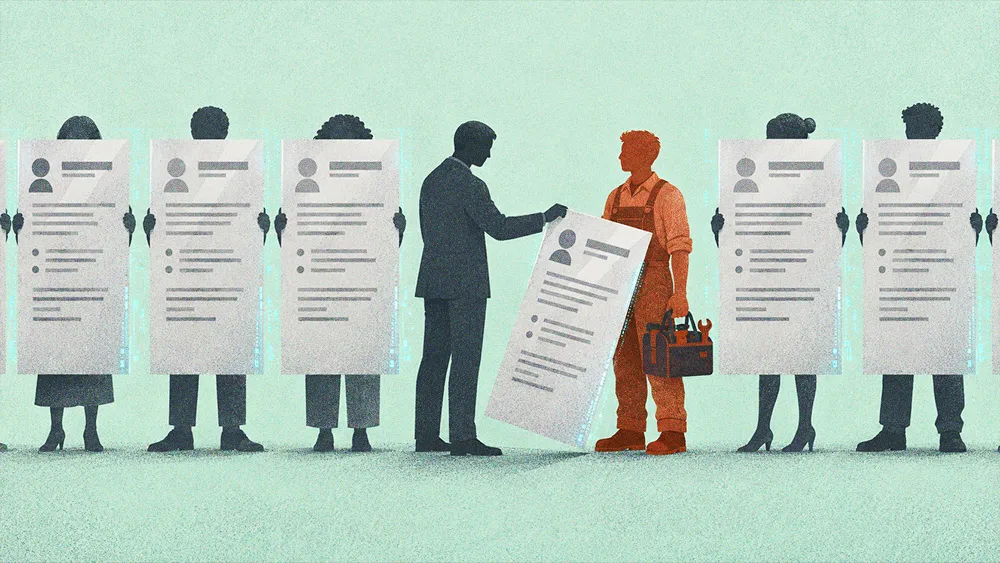



Employers need to be asking different questions. Not what do you have, but what have you done, and what can you do.
 Susan NewmanExecutive Director @ school2life
The first cut in most hiring processes rewards the candidates who describe themselves well, but those aren't always the same individuals who can do the work. A large share of the capability an employer is trying to hire never makes it onto the document being screened, not because the candidate lacks it, but because no one ever taught them how to connect what they've done to what the job needs. Employers are losing them to a gap that's fixable on both sides.
Working to close this gap is Susan Newman, Executive Director of school2life, a Chicago organization that works with students, recent graduates, and mid-career professionals on how to present their experience to employers. Two decades spent coaching candidates on one side of the hiring process and advising organizations on the other have led her to a clear diagnosis: the problem isn't competence, but professional fluency.
"A lot of people are qualified, but we haven't actually taught them how to convey their qualifications in a way that's sophisticated, relevant, and confident," Newman says. That gap between what people can do and what they can articulate is, in her view, the real reason many qualified people get passed over.
The gap is thin, but deep
In Newman's telling, professional fluency is the ability to take work you've already done and explain why it matters for the job in front of you, including the measurable part: the result, the deliverable, or what actually moved the needle. She's quick to point out that the people who lack it aren't the unqualified ones. The deficit is narrow and specific, which is exactly what makes it so costly when the process treats it as a proxy for capability. "There's a very thin but very deep gap in professional fluency," she says. "If you can't talk about how what you've done is relevant and applicable, then we have a huge gap."
She sees the pattern most clearly with early-career candidates, who often can't see which of their own experiences carry weight. As a result, they unintentionally leave the most relevant ones out entirely. "They don't even understand the value of all the experiences they've had, so how can they possibly convey that?" she points out.
It is not only a junior problem. Newman says more senior candidates undersell too, reporting a result without emphasizing what they personally did to produce it, or flattening a hard-won project into a line that reads as generic. The fluency gap spans the experience spectrum, and in every case the effect is that real capability never becomes legible to the person doing the hiring.
AI is widening the gap
The pressure to sort applicants quickly keeps rising, and the tools meant to help are making the underlying problem worse. AI now lets a candidate apply to dozens of roles in the time it once took to apply to one, and much of what reaches a recruiter reads the same from one applicant to the next. When everyone's self-presentation is machine-smoothed, judging candidates on how they write about themselves becomes even less reliable than it already was.
Newman's concern is that this pushes both sides toward the wrong game. Candidates optimize to get past the filter rather than to be understood, and employers screen on polish that no longer distinguishes anyone. "Everyone's using AI to get past the AI. It's unfortunately knocking a lot of great candidates out," she says. "I think employers are missing some fantastic talent."
The result is a hiring process increasingly organized around clearing an automated hurdle, at exactly the moment the automated hurdle has lost its ability to tell people apart. The fluency that would actually differentiate a strong candidate is the thing an AI-first flow is least equipped to surface.
How employers can draw out fluency
When candidates struggle to articulate their value unaided, the practical move for employers is to start asking in a way that pulls it out. This is where Newman points to the behavioral interview, not as the centerpiece of hiring, but as one accessible tool for closing the fluency gap on the employer's side of the table. "A behavioral interview cites specific instances to understand how a candidate will work in the future based on how they've worked in the past," she notes.
The value of asking a candidate to walk through a specific situation they've handled is that it does the work the candidate had trouble doing alone. It surfaces the judgment, decision-making, and collaboration that a resume often compresses into nothing, and it lets an interviewer evaluate substance rather than phrasing. The broader principle Newman draws applies well beyond any single interview format. "Employers need to be asking different questions. Not what do you have, but what have you done, and what can you do," she says.
A shared gap with a shared fix
Newman is clear that the durable solution starts long before anyone applies, in schools and career centers where people either learn to talk about their own work or never do. "Think about show and tell," she says. "We drop show and tell in second grade, but all we do to get anywhere in life is show and tell what we've done." She puts real responsibility on education, as well as on candidates themselves, but she's equally clear that employers have both a near-term opening and a direct incentive to close the gap from their side because the talent they're missing is talent they could be hiring now.
The stakes, in Newman's view, are not only about filling roles, but about the connections a broken process subtly forecloses. "There a lot of qualified people, and both sides are missing great conversations that move can people and business forward," she says.