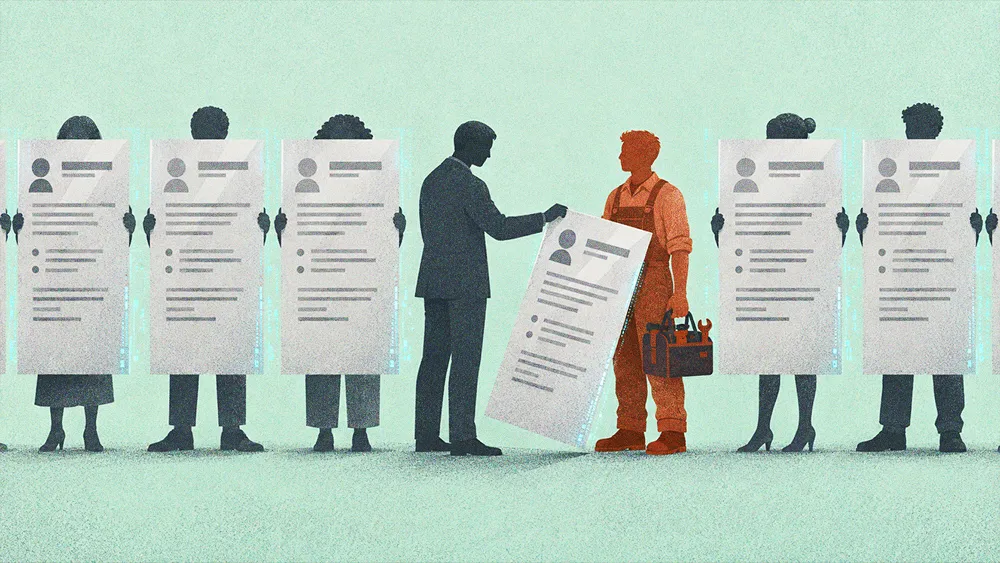



If the position doesn't call for extra steps, making people jump through hoops doesn't make sense.
 Kat MenkeTalent Acquisition Specialist, Sellenriek Family of Companies
Applying for a job doesn't always mean a candidate will be easy to reach. Recruiters increasingly encounter unanswered calls, AI-powered call screening, and unreliable phone reception, all of which can delay initial conversations. With Criteria's Hiring Benchmark Report finding that 52% of hiring professionals report greater hiring difficulties in 2026, recruiters must maintain meaningful screening standards while accounting for circumstances that may have little to do with a candidate's qualifications.
Kat Menke, Talent Acquisition Specialist at Sellenriek Family of Companies, manages recruiting across five business groups, filling positions ranging from construction laborers and equipment operators to supervisors and administrative professionals. Her experience in agency and corporate recruiting has taught her to adjust screening expectations to the requirements and working conditions of each role.
"I have different expectations for different positions. That comes with time and understanding what candidate responses to expect," Menke says. Although she values direct conversations with applicants, reaching them has become an increasingly difficult part of her work.
Reaching candidates is becoming a screening challenge of its own
Menke regularly encounters applicants who submit multiple applications but remain unreachable when she tries to contact them. Some live in areas with unreliable cellular coverage, while others use AI-powered call screening systems that interfere with scheduled interviews. "Now there's a secondary step. I've got to get through somebody's freaking secretary, which is their AI system," she says.
Texting can help overcome those barriers, and Menke acknowledges that calling candidates may create additional work. Still, she prefers direct conversations for the insight they provide. "Sometimes it's ten minutes; sometimes it's five. I can tell right away if somebody knows what they're talking about," Menke says.
Screening expectations should reflect the job
Menke holds candidates for higher-paying professional positions to different standards of punctuality and preparation than applicants working in physically demanding roles. "I might be more flexible with a laborer. If it's a professional role paying $100,000 a year, I expect that person to answer the call on time and be prepared," she says.
Employment history also requires context. A laborer who has held six jobs in five years may still be a suitable candidate, given the turnover associated with those positions. The same employment pattern raises more concerns for someone applying to become a construction supervisor. "There's more flexibility around job tenure and job hopping in our lower-level positions because they're high-turnover, high-volume roles," Menke explains.
Standardized interviews don't work for every position
Effective screening requires a clear understanding of what hiring managers need. Menke adapts interview questions to each applicant's background. "There is a certain format I follow, but it's not the same every time," she says. "It depends on what I see on the application and resume, and what my previous experience tells me to ask." When candidates repeatedly blame former colleagues or supervisors, she asks, "Is there anything you could have done differently in that position?" Their responses help her assess accountability and self-awareness.
Practical requirements also shape screening. Menke verifies credentials for positions requiring a commercial driver's license and discusses compensation early to identify potential mismatches. "We talk about pay rates immediately. I don't want to waste anybody's time, and I don't want anyone to feel I'm wasting theirs," she says.
For certain positions, phone interviews provide sufficient information, particularly when candidates are uncomfortable with video conferencing technology. "We're not going to make their lives difficult because we need them. If the position doesn't call for extra steps, making people jump through hoops doesn't make sense," Menke says.
Hiring outcomes help shape future screening decisions
Menke estimates that approximately 90% of the candidates she presents to hiring managers receive offers. She has also seen improvements in the company's 90-day retention rate. "I'm not only bringing in the right people; they're staying," she says. Retention also informs her sourcing decisions. After finding that hires recruited through Facebook weren't staying with the company, Menke paused that channel and focused on other recruitment channels, referrals, and previous applicants. "When something doesn't work for me, I find a different way to make it work," she concludes.