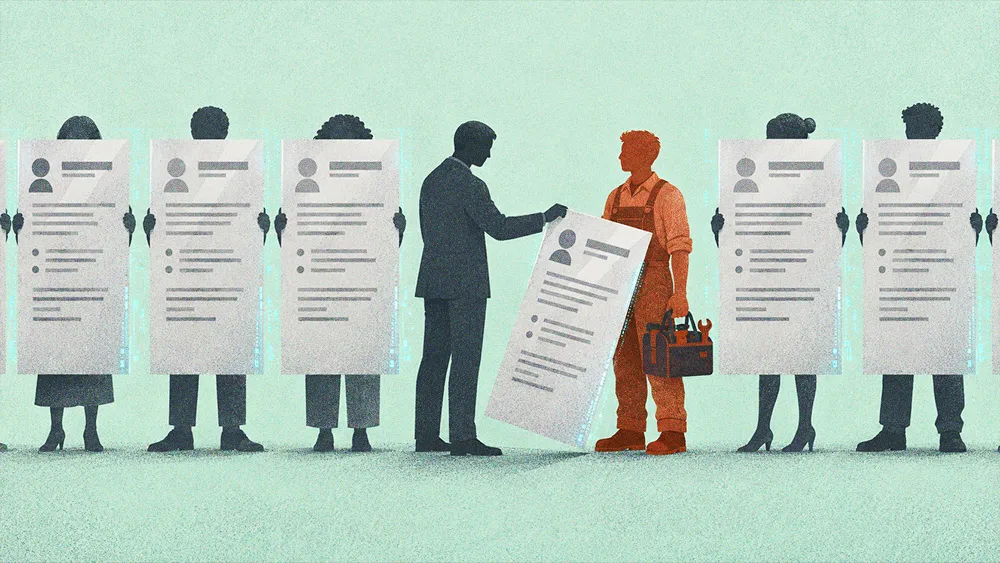



Ask a talent leader what they actually believe about AI screening, or skills-based hiring, or how much of a given interview answer was written by a chatbot, and you tend to get some version of the same response. They aren't sure. It isn't for lack of reading. The trouble is they've read a great deal of it and can't tell which parts hold up.
That's the condition this publication was built for.
The category produces an enormous volume of content, and very little of it survives contact with scrutiny. Vendor performance claims go unvalidated. A survey with a thin sample gets cited for three years by people who never opened the methodology. Every quarter LinkedIn arrives at a new consensus about what hiring is becoming, and every quarter it quietly abandons the last one. Meanwhile the recruiter running a req she didn't write still has a decision due Friday.
Call it a signal problem. It's the same trouble this industry has with résumés, moved up a level.
What this is
There is a working desk behind this. Reporters and editors on a real publishing schedule, sourcing from named practitioners instead of anonymous industry experts, reading studies before writing about them.
Coverage runs across three areas. The first is AI and technology, though what interests us is what these tools do to a live hiring funnel, not what the category page claims about them. The second is growth and strategy, meaning the operational decisions that settle who gets hired long before anyone opens an application. Leadership is the third, and in practice that means getting the people accountable for those decisions on the record.
Recent work gives some sense of the range. SHRM CEO Johnny C. Taylor Jr. explained why the skills-first movement stalled once employers dropped the degree requirement without building anything to measure skill in its place. We covered research showing that a convincing synthetic candidate can now be assembled in roughly seventy minutes. Another piece made the case that forty percent of turnover landing inside the first year is a selection failure rather than a retention one. Carlyne Ervin, VP of Human Resources at Chrysalis, argued that companies should keep measuring workforce data even with the EEO-1 mandate facing repeal.
Criteria appears in none of those stories.
Who pays for it
Criteria funds this publication, and we'd rather say so near the top of the launch piece than tuck it into a footer. A newsroom that opens with its own say-do gap has no business writing about anyone else's.
The arrangement works roughly like this. Criteria pays for the desk and gets no vote on what it publishes. We cover the whole category, including the parts Criteria competes in, and including the situations where the honest answer is that assessment won't fix the problem. Criteria research gets labeled as Criteria research and held to the standard we'd apply to a study from anywhere else. Sources get to say what they said, and a headline doesn't get to promise more than the reporting underneath it supports.
That's a narrower commitment than the phrase "editorial independence" usually implies. We'd rather make a small promise and keep it.
Why a company that sells assessments is doing this
Criteria has spent twenty years working on one fairly unglamorous question, which is how you tell what a person is capable of. The company has run more than 80 million assessments for over 4,000 organizations across 60 countries, with a team of I/O psychologists and a scientific advisory board attached to the validation work.
Almost none of that ever reaches the people who could use it. It sits in technical manuals and validation studies, and gets discussed at conferences attended largely by other psychometricians. The practitioner making a real hiring decision on a Tuesday afternoon gets a webinar instead.
You can't close a gap like that with a product pitch. You close it with a publication that treats the reader as somebody with a job to do. If a talent leader reads this for two years, never buys a thing from Criteria, and runs a better process at the end of it, the newsroom will have done what we built it to do. We're fine with that trade, and it's most of the reason this is worth funding.
What we want from you
Reporting improves when practitioners talk to it. So if you're running a process that works, or sitting on internal numbers that contradict what everyone says is true, or watching something break that nobody has written about yet, send it over. The desk reads everything that comes in.
Come for the news, come back for the signal.
Subscribe to Talent Signal News
The Talent Signal Newsdesk